

When Chasing the Market Becomes the Risk
A strong market can make risk feel smaller than it is. That is when discipline can be most important.

Strong markets have a way of making investors feel underinvested.
That tension gets more interesting when you look at who is choosing patience. Jamie Dimon recently said he would not be a buyer of equities or long-dated U.S. Treasurys at current prices (CNBC). Berkshire Hathaway ended the first quarter of 2026 continuing to build its cash positions, while remaining a net seller of stocks (Motley Fool).
When some of the most disciplined capital allocators in the world are emphasizing patience, while broad investors appear to be leaning further into stocks, it is worth asking what that tells us about the current setup.
The higher prices go, the easier it becomes to believe the real risk is not owning enough of what has already worked. Technology has carried much of the move. Markets are near all-time highs. And investors naturally start wondering if they should do more.
This is where discipline enters the equation. It does not mean the market has to collapse, or you have to go to cash. This is not fear mongering. But the risk-reward tradeoff may be shifting.
The question is not whether the market can keep going. It can. We really have to ask whether the probability still favors adding risk here, or whether the setup is starting to argue for more discipline.
This is where the question I wrote about recently on Money Decision Lab becomes so important: what is this money supposed to do? Strong markets can make risk feel smaller than it is. That is exactly when investors need to reconnect the portfolio to the purpose behind it.
Valuation and Sentiment Are Stretched
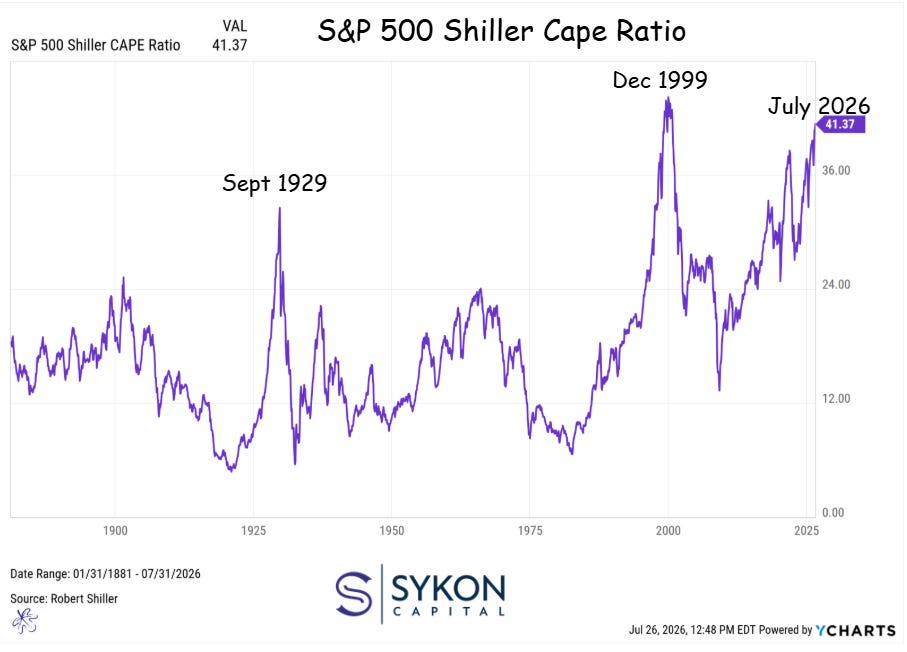
Shiller CAPE remains near historically elevated levels, suggesting valuations are leaving less room for disappointment.
Start with valuation. The Shiller CAPE ratio is sitting around 41 times earnings, near some of the highest levels in history. While valuation is not a timing signal, it can indicate probability.
When investors pay a high price for earnings, more has to go right. Earnings have to hold up. Expectations have to be met. Rates cannot create too much pressure. The higher the bar, the less room there is for disappointment.
Investor Positioning Is Also Extended
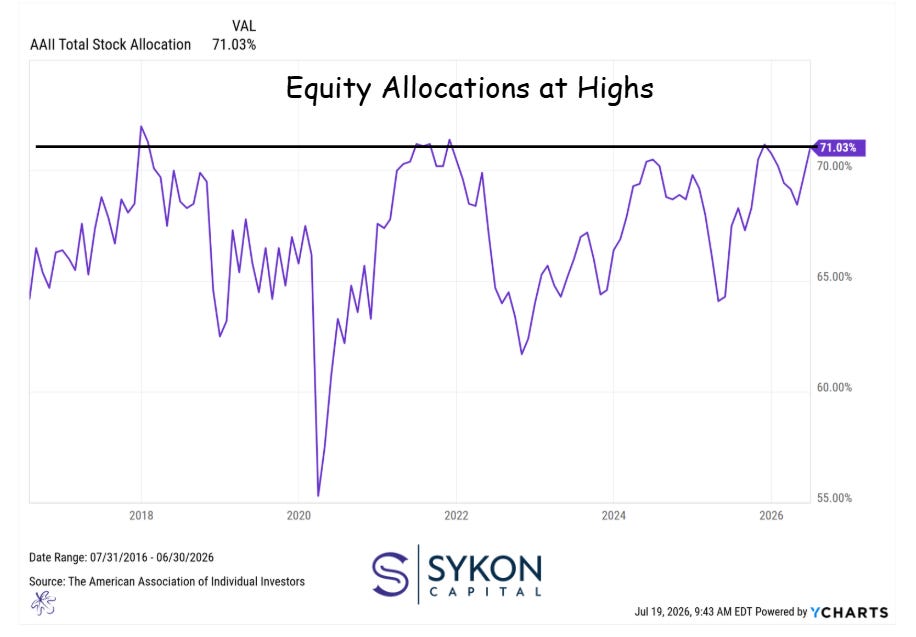
Investor stock allocations remain elevated, which may reflect performance chasing or portfolio drift after a strong market run.
That same backdrop is showing up in investor positioning. The latest AAII Asset Allocation Survey has stock exposure around 71%, with bonds around 14% and cash around 15%. That is elevated, and near the high end of what we have seen over the last decade.
Again, this is not about timing, it is about probability. It suggests broad investors may already be leaning heavily into the equity story, either by chasing what has worked or by simply letting stock exposure drift higher without much discipline.
Credit Is Sending the Same Message
Credit is saying something similar. High-yield option-adjusted spreads remain historically tight. The ICE BofA US High Yield Index Option-Adjusted Spread was 277 basis points as of July 23, 2026, according to FRED.
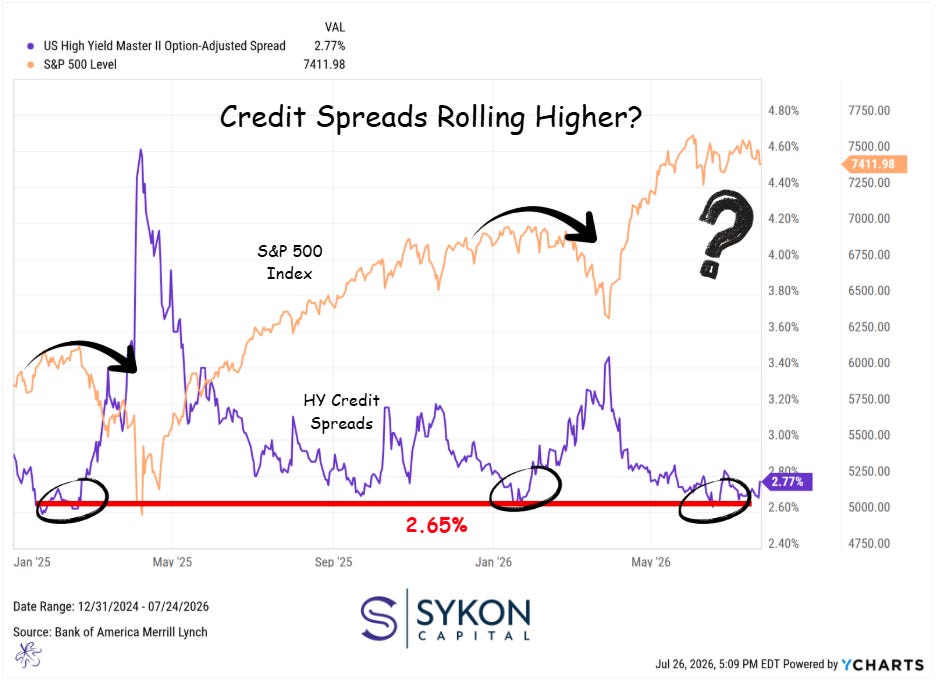
Tight high-yield spreads suggest investors are not being paid much extra for taking credit risk.
Tight spreads mean investors are not demanding much extra compensation for credit risk. Spreads do not stay tight forever. They compress, then eventually they expand. Are investors are being paid enough for that risk today?
We have seen this setup before. When spreads have pushed toward the 2.65% area, they later widened aggressively and equity markets felt it. The same thing does not have to happen now, but it does raise the question of whether investors are being compensated for taking the additional risk.
The Weakest Credit Is Where Problems Can Start
Under the surface, the weakest credit may already be moving. CCC-rated spreads have been rising. These are among the lowest quality borrowers that have not already defaulted.
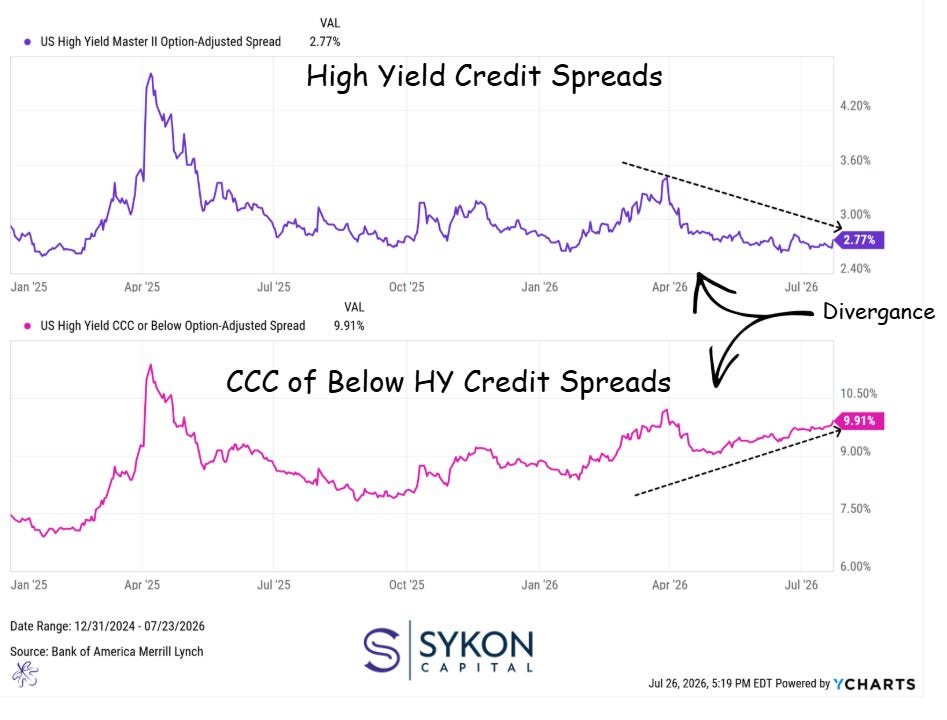
CCC spreads have started to rise, which may signal that lower quality credit is beginning to reprice risk first.
In my experience, credit problems often start at the weakest part of the market first. If investors are demanding more yield from lower quality borrowers, it may be an early sign they are becoming more selective about risk.
Does this stay contained or eventually works its way into the broader high-yield market? If risk is starting to reprice at the weakest credits first, investors should be careful about assuming the rest of the credit market is insulated. This should be a particular point of focus if you own private credit investments.
Technology and Seasonality Add to the Setup
At the same time, technology and the Nasdaq appear to be forming a potential diamond top pattern. I would not use that by itself, but if it breaks lower, it could fit the broader message from valuation, sentiment, and credit: the market may be fragile right now.
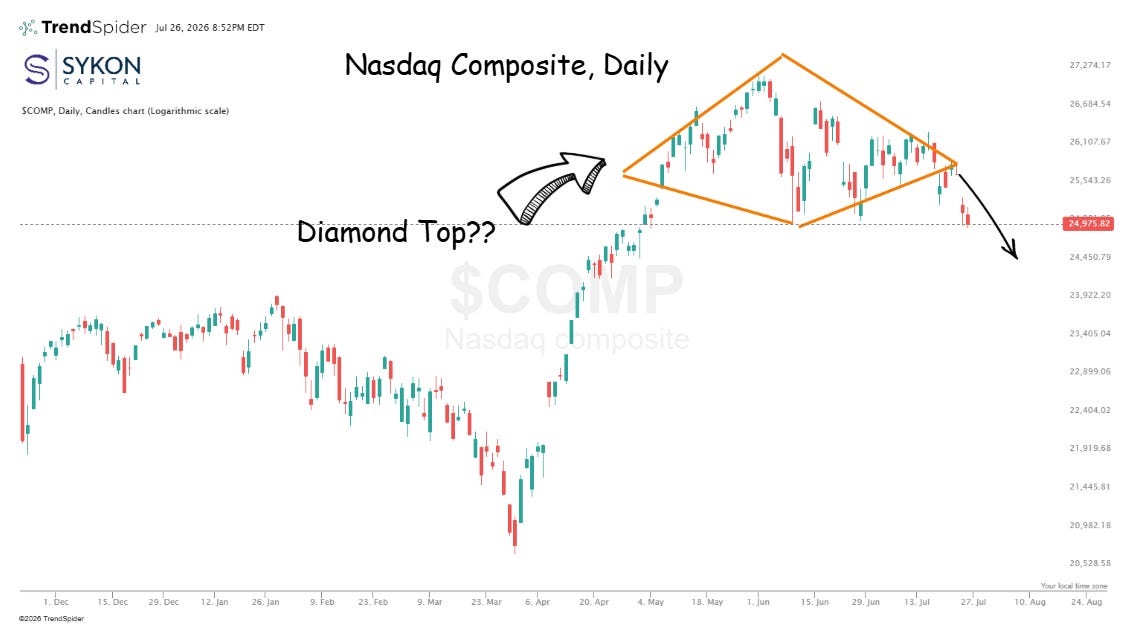
A potential diamond top in the Nasdaq would add to the broader message that market leadership may be losing momentum.
Seasonality adds one more dynamic. July has historically been one of the stronger months for stocks. Over the last 20 years, July has averaged roughly 2.47% for the S&P 500 and has been positive about 80% of the time.
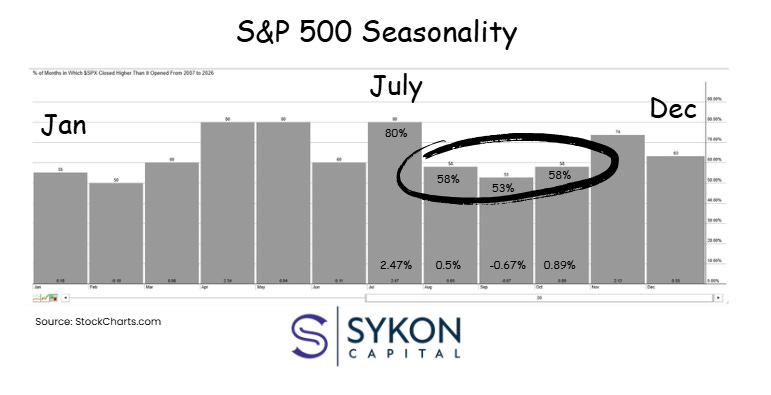
Market seasonality tends to soften after July, adding another reason to question whether the risk-reward setup is still favorable.
This July has been more modest, and we are moving into a weaker seasonal window. August has averaged roughly 0.50%, September about negative 0.67%, and October roughly 0.89% over that same period.
Seasonality does not predict the future. But when stretched positioning, rich valuations, tight spreads, expanding CCC spreads, a possible technology reversal, and softer seasonality all show up together, the reality becomes whether the probability still favors chasing more risk from here.
So What Should Investors Do?
It is easy to point to charts and say, “be careful.” The harder and more useful question is whether anything in your portfolio is being driven by the plan, or by the feeling that you need to catch up.
In my opinion, this is not a moment to abandon your plan. This is when you need to stick with it. Maintain your asset allocation and discipline. If the market is tempting you to change your allocation, reflect on whether your plan actually requires that change.
If your plan is built around a reasonable required return, I believe you do not need to chase maximum performance. Chasing usually means taking more equity risk, more concentration risk, or more credit risk at the exact moment the setup may be getting less forgiving.
On the equity side, discipline may mean moving up in quality, trimming speculative positions, reducing concentration, diversifying out of big winners, or focusing more on companies with stronger fundamentals. The goal is not to sell everything, but to make sure the risk you are taking is intentional.
On the fixed income side, discipline may mean being careful about how much credit risk you are taking. Tight spreads mean investors may not being paid much to move down in quality. High-yield bonds can get hurt if spreads widen. Private credit is not marked the same way public high-yield bonds are, but it is still exposed to many of the same underlying credit risks. If spreads widen and liquidity tightens, investors may find out that about this the hard way, it may just take longer to reflect in the values.
That is why credit quality and duration should be in focus. Moving up in quality can mean favoring Treasuries or investment-grade bonds instead of reaching too far for yield. On duration, investors still need to be thoughtful because higher rates can pressure longer-duration bonds.
Portfolios should adapt as markets change. But adaptation is different from chasing.
The Bottom Line
This is not about predicting the next 5% move. The real question is - does the probability look better for a clean move higher, or for a period where volatility starts to become meaningful again?
Maybe the market keeps grinding higher. Maybe it moves sideways or volatility picks up before anything larger develops. But with sentiment stretched, valuations rich, spreads tight, lower quality credit weakening, technology showing fatigue, and seasonality getting less favorable, the setup may not be as one-sided as it feels when markets are near highs.
That is why this is a good time to revisit your allocation, concentration risk, credit exposure, and the role each piece of the portfolio is supposed to play.
I do not think investors need to copy Berkshire Hathaway or Jamie Dimon. Their time horizons, balance sheets, and opportunity sets are different. Though when disciplined investors are emphasizing patience at the same time retail investors are letting equity exposure drift higher, that contrast is worth paying attention to.
I will be covering this in more detail in an upcoming video discussion. We will walk through the charts, the credit setup, valuations, the Nasdaq pattern, and how investors can think through risk from here. Be sure to subscribe if you want to follow along.
Final thought, a strong market can talk investors into taking risks their plan never required. The real discipline is knowing when to listen to the plan instead.
About the Author
Todd Stankiewicz | President & Chief Investment Officer, SYKON Capital
Todd Stankiewicz is Chief Investment Officer at SYKON Capital, a fee-based registered investment advisor with offices in Westchester County, NY and Jupiter, FL. He is a recurring guest on Fox Business and the Schwab Network. He helps lead the firm’s investment strategy, portfolio construction, and market research. Through Market Mindset, Todd focuses on investor behavior, technical analysis, and portfolio decision-making in real time, helping investors understand not just what markets are doing, but how to think through them with discipline. Todd is also a Portfolio Manager for the Free Markets ETF (FMKT). Todd can be reached at todd@sykoncap.com
Advisory Services offered through SYKON Capital LLC, a registered investment advisor with the U.S. Securities and Exchange Commission. This material is intended for informational purposes only. It should not be construed as legal or tax advice and is not intended to replace the advice of a qualified attorney or tax advisor. The information contained in this presentation has been compiled from third party sources and is believed to be reliable as of the date of this report. Past performance is not indicative of future returns and diversification neither assures a profit nor guarantees against loss in a declining market. Investments involve risk and are not guaranteed.